He caught TB in med school,
bending over the corpses
of bums who died in the street.
He was sent away to rest,
surrender to the only cure:
rest, no exercise, sleep.
And so he read: Nietzsche,
Proust, and his favorite,
“the melancholy Dane.”
Happiness was despair,
he learned, even in America:
smug faces in the checkout lines,
a nation that believed
in bigger cars, more pills,
better bombs.
He thought about his ancestors,
their Delta plain and seas
of cotton, men who were
merely stoics at the end…
One day, he checked himself
out, drove across the country
to New Mexico.
He walked outside, night
after night, his heart
turning to a painful stone.
He saw the darkness between
the distant stars, faint light
at best.
But what if the sky
was only a book, open
to another, more careful
reading?
Out there, in the desert,
anything was possible,
even God.
~~~~~~~~
– William Miller
Literary Review, Winter
2004, Vol. 47 Issue 2, p. 103-4
Showing posts with label poetry. Show all posts
Showing posts with label poetry. Show all posts
Friday, July 8, 2011
Percy as Poem
I've been feasting on the archives at Korrectiv when I should be working.


Wednesday, March 30, 2011
Our Heroine Has A Contrite Heart
Out Heroine has been exerting entirely too much control over her life lately, and so it comes as no surprise to her that the results are so unsatisfactory & underwhelming. Y'all, William Cowper knew what ailed me back in 1779:
A Contrite Heart
THE Lord will happiness divine
On contrite hearts bestow;
Then tell me, gracious God, is mine
A contrite heart or no?
I hear, but seem to hear in vain,
Insensible as steel;
If aught is felt, ‘tis only pain
To find I cannot feel.
I sometimes think myself inclined
To love thee, if I could;
But often feel another mind,
Averse to all that’s good.
My best desires are faint and few,
I fain would strive for more:
But when I cry, “My strength renew,”
Seem weaker than before.
Thy saints are comforted, I know,
And love thy house of prayer;
I therefore go where others go,
But find no comfort there.
O make this heart rejoice or ache;
Decide this doubt for me;
And if it be not broken, break,
And heal it if it be.
Tuesday, March 8, 2011
Tuesday Poetry Shot: Pushkin
From Alexsandr Pushkin, one of the most romantic poems of all time. Our Heroine is a sucker for men with broken hearts.
When I read this in high-school, I was so moved by it that I memorized it (and a few other romantic tearjerkers).
Years later, visiting Russia, I discovered that our guide had also loved and memorized this poem (albeit, in Russian), and so we recited it together (her in Russian, me in English), each to the other. That someone else should feel sorry for Pushkin, and the anguish he felt that wrung this poem out of him, and that these two people should meet by chance and recognize eachother as kindred spirits, was just so cool.
It remains one of my favorite memories of that trip.
I loved you.
Even now I may confess,
Some embers of my love their fire retain,
But do not let it cause you much distress,
I do not want to sadden you again.
Hopeless and tongue-tied, yet I loved you dearly
With pangs the jealous and the timid know;
So tenderly I loved you, so sincerely,
I pray God grant another love you so.
When I read this in high-school, I was so moved by it that I memorized it (and a few other romantic tearjerkers).
Years later, visiting Russia, I discovered that our guide had also loved and memorized this poem (albeit, in Russian), and so we recited it together (her in Russian, me in English), each to the other. That someone else should feel sorry for Pushkin, and the anguish he felt that wrung this poem out of him, and that these two people should meet by chance and recognize eachother as kindred spirits, was just so cool.
It remains one of my favorite memories of that trip.
Saturday, October 17, 2009
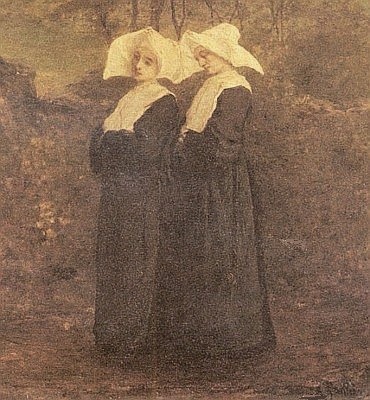
Nuns of the Perpetual Adoration
Calm, sad, secure; behind high convent walls,
These watch the sacred lamp, these watch and pray:
And it is one with them when evening falls,
And one with them the cold return of day.
These heed not time; their nights and days they make
Into a long, returning rosary,
Whereon their lives are threaded for Christ’s sake;
Meekness and vigilance and chastity.
A vowed patrol, in silent companies,
Life-long they keep before the living Christ.
In the dim church, their prayers and penances
Are fragrant incense to the Sacrificed.
Outside, the world is wild and passionate;
Man’s weary laughter and his sick despair
Entreat at their impenetrable gate:
They heed no voices in their dream of prayer.
They saw the glory of the world displayed;
They saw the bitter of it, and the sweet;
They knew the roses of the world should fade,
And be trod under by the hurrying feet.
Therefore they rather put away desire,
And crossed their hands and came to sanctuary
And veiled their heads and put on coarse attire:
Because their comeliness was vanity.
And there they rest; they have serene insight
Of the illuminating dawn to be:
Mary’s sweet Star dispels for them the night,
The proper darkness of humanity.
Calm, sad, secure; with faces worn and mild:
Surely their choice of vigil is the best?
Yea! for our roses fade, the world is wild;
But there, beside the altar, there, is rest.
Ernest Dawson

These watch the sacred lamp, these watch and pray:
And it is one with them when evening falls,
And one with them the cold return of day.
These heed not time; their nights and days they make
Into a long, returning rosary,
Whereon their lives are threaded for Christ’s sake;
Meekness and vigilance and chastity.
A vowed patrol, in silent companies,
Life-long they keep before the living Christ.
In the dim church, their prayers and penances
Are fragrant incense to the Sacrificed.
Outside, the world is wild and passionate;
Man’s weary laughter and his sick despair
Entreat at their impenetrable gate:
They heed no voices in their dream of prayer.
They saw the glory of the world displayed;
They saw the bitter of it, and the sweet;
They knew the roses of the world should fade,
And be trod under by the hurrying feet.
Therefore they rather put away desire,
And crossed their hands and came to sanctuary
And veiled their heads and put on coarse attire:
Because their comeliness was vanity.
And there they rest; they have serene insight
Of the illuminating dawn to be:
Mary’s sweet Star dispels for them the night,
The proper darkness of humanity.
Calm, sad, secure; with faces worn and mild:
Surely their choice of vigil is the best?
Yea! for our roses fade, the world is wild;
But there, beside the altar, there, is rest.
Ernest Dawson
Wednesday, August 19, 2009
Our Heroine Admits There May Be Something In What Old Wordsworth Had To Say
When I was in college I studied the English Romantics for one whole semester. All these years later, I don't remember much except Samuel Taylor Coleridge was my all-around favorite, John Keats was tragic, Lord Byron was dreamy and I didn't much care for William Wordsworth.
To my mind at the time, Wordsworth's poems were narcissistic to the point of annoyance. He filtered everything through his imagination and then had to sing about it, and I was disgusted that he wrote an autobiographical poem, The Prelude, when (to me) poems ought to be many things, but your boring autobiography was not one of them. Forgive me, Wordsworth, I was only 18, and none too intelligent.
Anyhow, I hadn't really thought about him for years, until I saw this article in City Journal in which Andrew Klavan makes the case that Wordsworth was the first "hippie" who grew up.
This kind of article may or may not be your thing, but it really did fire in me a new respect for old Wordsworth, and I think I will brush off my Romantics anthology and read, if not The Prelude, than at least Lyrical Ballads again. Maybe you'll feel the same way, but if not, here's a short one in his honor: "The World Is Too Much With Us" (a favorite of mine even back then).
The World Is Too Much With Us
To my mind at the time, Wordsworth's poems were narcissistic to the point of annoyance. He filtered everything through his imagination and then had to sing about it, and I was disgusted that he wrote an autobiographical poem, The Prelude, when (to me) poems ought to be many things, but your boring autobiography was not one of them. Forgive me, Wordsworth, I was only 18, and none too intelligent.
Anyhow, I hadn't really thought about him for years, until I saw this article in City Journal in which Andrew Klavan makes the case that Wordsworth was the first "hippie" who grew up.
As the century turned, the dream of French liberty finally died. The old tyranny gave way to a new one, as Burke had predicted. To Wordsworth’s disgust, Napoleon Bonaparte became emperor and “now, become oppressors in their turn, / Frenchmen had changed a war of self-defence / For one of conquest, losing sight of all / Which they had struggled for.”
It was, for Wordsworth, what the failure of Communism was for the radicals of a later day. He could no longer deny the error inherent in “speculative schemes— / That promised to abstract the hopes of Man.” He saw the Revolution as a dream that “flattered the young, pleased with extremes” and made “Reason’s naked self / The object of its fervour.” Confused by pure reason’s failure as a moral guide, he “lost / All feeling of conviction” and “yielded up moral questions in despair.” Slowly, he began to do the brave and difficult thing: to admit he had been wrong and change his mind.
This kind of article may or may not be your thing, but it really did fire in me a new respect for old Wordsworth, and I think I will brush off my Romantics anthology and read, if not The Prelude, than at least Lyrical Ballads again. Maybe you'll feel the same way, but if not, here's a short one in his honor: "The World Is Too Much With Us" (a favorite of mine even back then).
The World Is Too Much With Us
          THE world is too much with us; late and soon,
          Getting and spending, we lay waste our powers:
          Little we see in Nature that is ours;
          We have given our hearts away, a sordid boon!
          The Sea that bares her bosom to the moon;
          The winds that will be howling at all hours,
          And are up-gathered now like sleeping flowers;
          For this, for everything, we are out of tune;
          It moves us not.--Great God! I'd rather be
          A Pagan suckled in a creed outworn;                         10
          So might I, standing on this pleasant lea,
          Have glimpses that would make me less forlorn;
          Have sight of Proteus rising from the sea;
          Or hear old Triton blow his wreathed horn.
Wednesday, August 12, 2009
Half In Love With Easeful Death Is No Way To Woo A Widow
I watched The Ghost and Mrs. Muir last night, because Heaven Knows, Mr. Allison had me on a bit of an "impossible love" kick, but it didn't move me like HK,MA. I don't think it's the story's fault, which I love in theory: young widow, moves into haunted seaside cottage, falls for ghost of crusty old sea captain which haunts the place, their love proves impossible (for obvious reasons). That part's fairly awesome. But the actors left much to be desired, which hurts me to write because Rex Harrison is The Best (especially as Henry Higgins, the quintessential crusty Brit). As the ghost of an old sea salt, however, he took the whole "crust" thing one step beyond the rabbit-proof fence. There were too many "Arrrrgghhhs," and "fetch me slippers, woman" and he wore a ridiculous beard that looked fake, with the end result being I just didn't buy him as an appealing love interest for the widow, especially since he's dead. You have to bring your A-game when you're a ghost looking for love, wouldn't you agree?
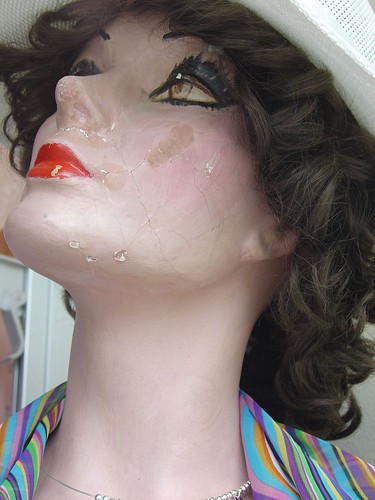
Gene Tierney, on the other hand, spends the entire move doing this:
Sticking her nose in the air in response to everything that's said to her, which was supposed to demonstrate that Mrs. Muir was a strong, independent woman, but really just made her exceedingly rude. Tierney looks lovely, though.
Anyhow, I found it a disappointment. However, one scene that made me happy was toward the beginning; Mrs. Muir tells the Captain his house reminds her of something, and he responds that he modelled it off lines from John Keats' Ode to A Nightingale, a poem that I have not read in years, though I loved it when I was studying the Romantics. For your sakes and mine, I have reprinted it below. The lines that inspired the Captain are in italics:
Gene Tierney, on the other hand, spends the entire move doing this:
Sticking her nose in the air in response to everything that's said to her, which was supposed to demonstrate that Mrs. Muir was a strong, independent woman, but really just made her exceedingly rude. Tierney looks lovely, though.
Anyhow, I found it a disappointment. However, one scene that made me happy was toward the beginning; Mrs. Muir tells the Captain his house reminds her of something, and he responds that he modelled it off lines from John Keats' Ode to A Nightingale, a poem that I have not read in years, though I loved it when I was studying the Romantics. For your sakes and mine, I have reprinted it below. The lines that inspired the Captain are in italics:
Ode to a Nightingale
1. MY heart aches, and a drowsy numbness pains | |
| My sense, as though of hemlock I had drunk, | |
| Or emptied some dull opiate to the drains | |
| One minute past, and Lethe-wards had sunk: | |
| ’Tis not through envy of thy happy lot, | 5 |
| But being too happy in thine happiness,— | |
| That thou, light-winged Dryad of the trees, | |
| In some melodious plot | |
| Of beechen green, and shadows numberless, | |
| Singest of summer in full-throated ease. | 10 |
2. O, for a draught of vintage! that hath been | |
| Cool’d a long age in the deep-delved earth, | |
| Tasting of Flora and the country green, | |
| Dance, and Provencal song, and sunburnt mirth! | |
| O for a beaker full of the warm South, | 15 |
| Full of the true, the blushful Hippocrene, | |
| With beaded bubbles winking at the brim, | |
| And purple-stained mouth; | |
| That I might drink, and leave the world unseen, | |
| And with thee fade away into the forest dim: | 20 |
3. Fade far away, dissolve, and quite forget | |
| What thou among the leaves hast never known, | |
| The weariness, the fever, and the fret | |
| Here, where men sit and hear each other groan; | |
| Where palsy shakes a few, sad, last gray hairs, | 25 |
| Where youth grows pale, and spectre-thin, and dies; | |
| Where but to think is to be full of sorrow | |
| And leaden-eyed despairs, | |
| Where Beauty cannot keep her lustrous eyes, | |
| Or new Love pine at them beyond to-morrow. | 30 |
4. Away! away! for I will fly to thee, | |
| Not charioted by Bacchus and his pards, | |
| But on the viewless wings of Poesy, | |
| Though the dull brain perplexes and retards: | |
| Already with thee! tender is the night, | 35 |
| And haply the Queen-Moon is on her throne, | |
| Cluster’d around by all her starry Fays; | |
| But here there is no light, | |
| Save what from heaven is with the breezes blown | |
| Through verdurous glooms and winding mossy ways. | 40 |
5. I cannot see what flowers are at my feet, | |
| Nor what soft incense hangs upon the boughs, | |
| But, in embalmed darkness, guess each sweet | |
| Wherewith the seasonable month endows | |
| The grass, the thicket, and the fruit-tree wild; | 45 |
| White hawthorn, and the pastoral eglantine; | |
| Fast fading violets cover’d up in leaves; | |
| And mid-May’s eldest child, | |
| The coming musk-rose, full of dewy wine, | |
| The murmurous haunt of flies on summer eves. | 50 |
6. Darkling I listen; and, for many a time | |
| I have been half in love with easeful Death, | |
| Call’d him soft names in many a mused rhyme, | |
| To take into the air my quiet breath; | |
| Now more than ever seems it rich to die, | 55 |
| To cease upon the midnight with no pain, | |
| While thou art pouring forth thy soul abroad | |
| In such an ecstasy! | |
| Still wouldst thou sing, and I have ears in vain— | |
| To thy high requiem become a sod. | 60 |
7. Thou wast not born for death, immortal Bird! | |
| No hungry generations tread thee down; | |
| The voice I hear this passing night was heard | |
| In ancient days by emperor and clown: | |
| Perhaps the self-same song that found a path | 65 |
| Through the sad heart of Ruth, when, sick for home, | |
| She stood in tears amid the alien corn; | |
| The same that oft-times hath | |
| Charm’d magic casements, opening on the foam | |
| Of perilous seas, in faery lands forlorn. | 70 |
8. Forlorn! the very word is like a bell | |
| To toil me back from thee to my sole self! | |
| Adieu! the fancy cannot cheat so well | |
| As she is fam’d to do, deceiving elf. | |
| Adieu! adieu! thy plaintive anthem fades | 75 |
| Past the near meadows, over the still stream, | |
| Up the hill-side; and now ’tis buried deep | |
| In the next valley-glades: | |
| Was it a vision, or a waking dream? | |
| Fled is that music:—Do I wake or sleep? |
Saturday, June 2, 2007
Who Made Our Heroine Love this Poem?
Fun with science and nature poems!
WHO MADE YOU FOR THE DARK?
Darkling beetle, black and shining jewel,
What jeweler could have formed you, with what tool?
What burr or jig or pliers set your shape,
On what suspended rod your armor draped,
On which round mold your head and thorax bent,
For whose joy were those elytra meant -
What burin graved the parallels that run
From point of wing to where the head’s begun?
Your mandibles that twist, your eyes that globe,
Your furred antennae delicate that probe
The galleries that run beneath the bark
Of dying trees – who made you for the dark?
Pavel Chichikov
WHO MADE YOU FOR THE DARK?
Darkling beetle, black and shining jewel,
What jeweler could have formed you, with what tool?
What burr or jig or pliers set your shape,
On what suspended rod your armor draped,
On which round mold your head and thorax bent,
For whose joy were those elytra meant -
What burin graved the parallels that run
From point of wing to where the head’s begun?
Your mandibles that twist, your eyes that globe,
Your furred antennae delicate that probe
The galleries that run beneath the bark
Of dying trees – who made you for the dark?
Pavel Chichikov
Thursday, May 3, 2007
Our Heroine Tells The Target
JAPANESE ARCHERY (H/T Alias Clio)
1.
The hand tells the bowstring:
Obey me.
The bowstring answers the hand:
Draw valiantly.
The bowstring tells the arrow:
O arrow, fly.
The arrow answers the bowstring:
Speed my flight.
The arrow tells the target:
Be my light.
The target answers the arrow:
Love me.
2.
The target tells arrow, bowstring, hand and eye:
Ta twam asi.
Which means in a sacred tongue:
I am thou.
3.
(Footnote of a Christian:
O Mother of God,
watch over the target, the bow, the arrow
and the archer).
Aleksander Wat
Translated by Richard Laurie
From My Century: The Odyssey of a Polish Intellectual. New York and London: Norton, 1988.
1.
The hand tells the bowstring:
Obey me.
The bowstring answers the hand:
Draw valiantly.
The bowstring tells the arrow:
O arrow, fly.
The arrow answers the bowstring:
Speed my flight.
The arrow tells the target:
Be my light.
The target answers the arrow:
Love me.
2.
The target tells arrow, bowstring, hand and eye:
Ta twam asi.
Which means in a sacred tongue:
I am thou.
3.
(Footnote of a Christian:
O Mother of God,
watch over the target, the bow, the arrow
and the archer).
Aleksander Wat
Translated by Richard Laurie
From My Century: The Odyssey of a Polish Intellectual. New York and London: Norton, 1988.
Sunday, April 22, 2007
Our Heroine Switches to Iced Coffee
It's 70 degrees outside y'all!
Algernon Charles Swinburne (1865)
For winter's rains and ruins are over,
And all the season of snows and sins;
The days dividing lover and lover,
The light that loses, the night that wins;
And time remembered is grief forgotten,
And frosts are slain and flowers begotten,
And in green underwood and cover
Blossom by blossom the spring begins.
Algernon Charles Swinburne (1865)
Thursday, April 5, 2007
Our Heroine Wishes You a Joyful Easter
I'll be gone for the Triduum, y'all, and back blogging on Monday. While I'm celebrating great and holy things by mainlining ham and manicotti in Vermont, I leave you a very lovely and appropriate poem by the wonderful John Donne:
Death be not proud, though some have called thee
Mighty and dreadful, for thou art not so,
For those whom thou think'st thou dost overthrow,
Die not, poor death, nor yet canst thou kill me.
From rest and sleep, which but thy pictures be,
Much pleasure, then from thee, much more must flow,
And soonest our best men with thee do go,
Rest of their bones, and soul's delivery.
Thou art slave to Fate, Chance, kings, and desperate men,
And dost with poison, war, and sickness dwell,
And poppy, or charms can make us sleep as well,
And better than thy stroke; why swell'st thou then?
One short sleep past, we wake eternally,
And death shall be no more; death, thou shalt die.
Death be not proud, though some have called thee
Mighty and dreadful, for thou art not so,
For those whom thou think'st thou dost overthrow,
Die not, poor death, nor yet canst thou kill me.
From rest and sleep, which but thy pictures be,
Much pleasure, then from thee, much more must flow,
And soonest our best men with thee do go,
Rest of their bones, and soul's delivery.
Thou art slave to Fate, Chance, kings, and desperate men,
And dost with poison, war, and sickness dwell,
And poppy, or charms can make us sleep as well,
And better than thy stroke; why swell'st thou then?
One short sleep past, we wake eternally,
And death shall be no more; death, thou shalt die.
Sunday, April 1, 2007
Our Heroine Gets Down to Business
Y'all, guess what I am on page 93 of? Hint: It's the whole reason this blog was started. That's right, The Iliad. Of course, the poem text only starts on page 81 of my translation, so let's not get too excited. But still!
"So," you ask, "what are you thinking of it at page 93?" Erm...I'm thinking...Agamemnon is...kind of a weenie.
Now, I know you're thinking, "I already knew that! Everybody knows that! Why not just say you noticed it's about the Trojan War, and be done with the obvious. Jeeze!" To which our heroine responds, "Look, I never promised y'all unique and exciting insights, just my thoughts, which are probably going to be the same thoughts that everyone in the history of the reading of this poem has thought."
Except, now I know why everyone thinks Agamemnon is such a weenie at the beginning of the poem. Because he is! He's selfish, immature and a bad leader of men. I'm not at all surprised that Achilles is teed off at him. But I am also very, very curious whether he stays this way. Something tells me he's going to have to eat crow for his bad behavior towards Achilles, and I wonder if that exercise in humility will ultimately change or redeem him.
Of course, this is probably what everyone wonders at page 93.
"So," you ask, "what are you thinking of it at page 93?" Erm...I'm thinking...Agamemnon is...kind of a weenie.
Now, I know you're thinking, "I already knew that! Everybody knows that! Why not just say you noticed it's about the Trojan War, and be done with the obvious. Jeeze!" To which our heroine responds, "Look, I never promised y'all unique and exciting insights, just my thoughts, which are probably going to be the same thoughts that everyone in the history of the reading of this poem has thought."
Except, now I know why everyone thinks Agamemnon is such a weenie at the beginning of the poem. Because he is! He's selfish, immature and a bad leader of men. I'm not at all surprised that Achilles is teed off at him. But I am also very, very curious whether he stays this way. Something tells me he's going to have to eat crow for his bad behavior towards Achilles, and I wonder if that exercise in humility will ultimately change or redeem him.
Of course, this is probably what everyone wonders at page 93.
Friday, March 30, 2007
Our Heroine Self-Identifies
I don't know whether it was my predilection for thingummies, or my hatred of climbing stairs, but somehow, I'm terza rima. Didn't you always suspect as much?
What Poetry Form Are You? |
Subscribe to:
Posts (Atom)
