 1) Today, over my morning coffee, I read the weekly "Worst Movie of All Time" review on Videogum. This week's movie was The Road to Wellville, which takes place at the turn of the 20th century (one of my favorite fashion periods).
2) After watching the accompanying clip, I thought to myself, "Bridget Fonda had really pretty red hair in that movie." (see right)
3) Pondering further her pretty red hair, I thought to myself, "I've seen her real hair. It's pin straight. Did she wear a wig? Otherwise, I wonder how did her hair get so gloriously big and wavy?"
4) I then thought to myself this was the same question I used to have about Megan Follows' hair in Anne of Avonlea, which was also very pretty and red (see below, and I've made sure Gilbert is in the shot for the ladies):
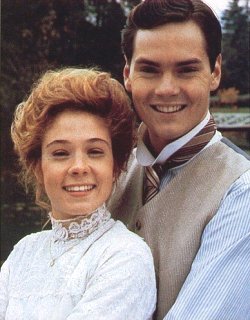 5) Then I thought to myself how it was a shame I am too old now to read and enjoy the Anne books as I did in high school, and I wondered if I would perhaps like rereading Anne of Ingleside, which takes place later in Anne's life, (closer to my age) when she has been married to Gilbert Blythe (!) for many years.
6) Then I thought to myself how I appreciated that L.M. Montgomery included tragedy in Anne's later life. How it made the books (and Anne) more real for me, and less like fairytales set in Canada. I recalled that Anne lost her first baby, Joy, and how she is described as never being the same after that.
7) Oh, but then, still thinking about those books, I said to myself, "Something else sad happens to her, but what was it? Oh, right, now I remember, in a later book, she loses her son Walter in the First World War."
8) THEN I got to thinking about Walter, the handsome, dreamy, poet son of Anne, and how tragic it was that he was the son who was afraid to go to war (unlike Jem and Shirley, her other sons who enlist right away), who delayed and delayed enlisting, but finally did enlist, and died doing something spectacularly brave and heroic.
9) Which finally got me off the books, and got me thinking about World War I, and how I'd been told somewhere (I think in a lecture of Professor Evans, talking about P.G. Wodehouse) that somehow, something about the pointlessness and brutality of that war broke the souls of the people who survived it, and how we have inherited the fruits of that brokenness.
10) That got me considering World War II, and how World War I must have been very different, because no one says World War II was pointless, even though it was brutal.
11) Then I thought to myself that I'd also read somewhere that World War II was a direct result of the Europe that World War I created. If we'd avoided the First World War, we need never have fought the Second World War.
12) Then I thought, "I know we fought the Germans in World War I, but somehow I know it was different, I don't think they were bent on world-domination likethey were under Hitler. And somehow Serbia was involved?" I couldn't really remember anything about it except it involved trenches, mustard gas, and someplace called Ypres.
13) Then I was deeply ashamed, my ignorance betraying a shocking ingratitude to the brave men who fought in that war.
14) So I determined then - and am still determined - to read a book about it.
15) But then I remembered I don't know any books about WWI that are well researched, informative, not driven by ideology, and also engaging (actually I don't know any books about WWI at all.). SO, I thought I would write this all out on my blog and maybe Little Brother or Frank or Dad or BMT or SLB or someone would have a recommendation.
So, y'all, if anyone has a recommendation for a good, non-fiction account of the roots and causes of World War One, the course of the war itself, and/or the aftermath and results of the war, I am all ears. Please keep in mind I am a fiction reader usually, so I'd prefer something written to be engaging for the girl who is just dipping her toe in, something like what Shelby Foote would have written if he hadn't been busy being awesome about the Civil War.
Many thanks!


